
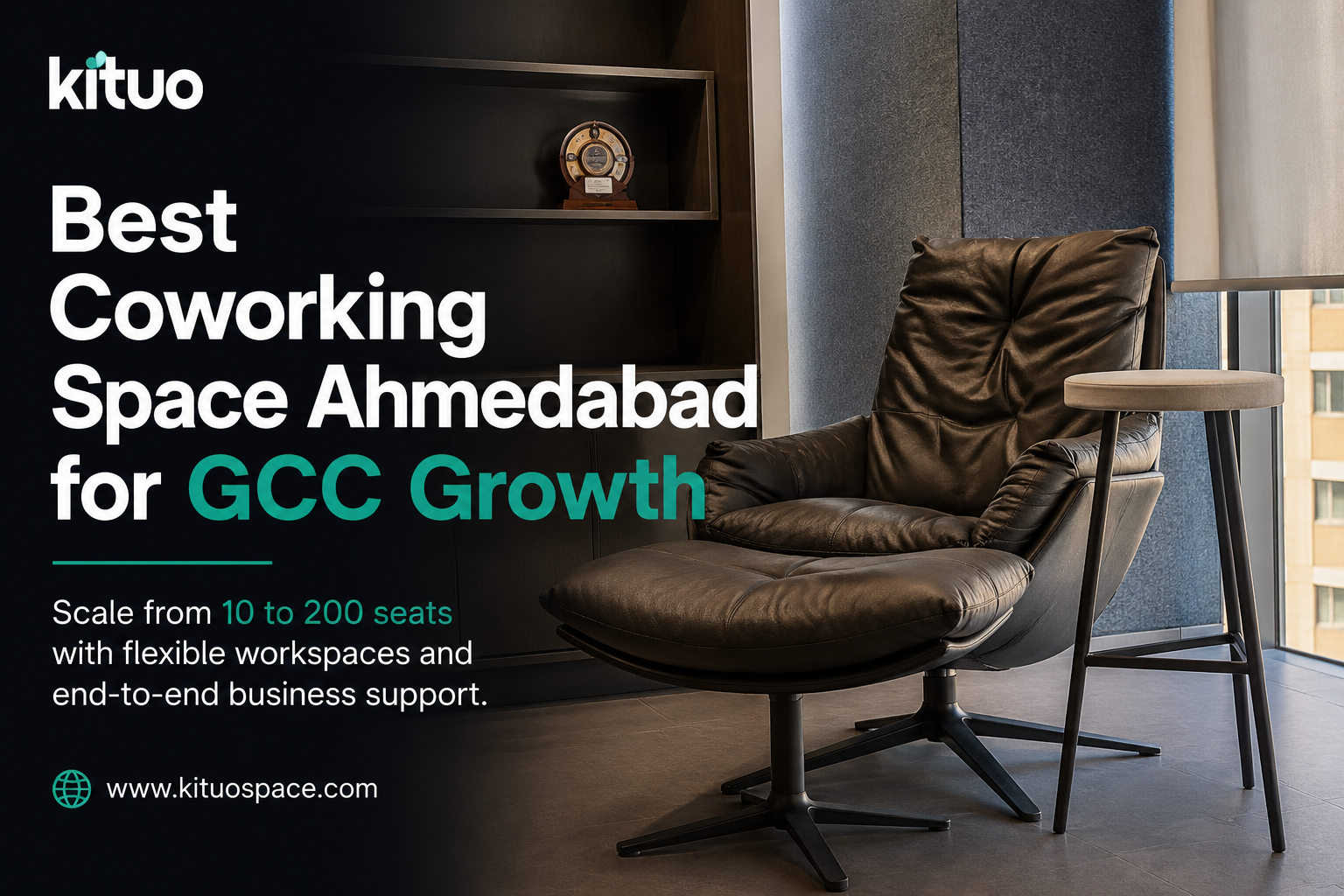
How Kituo Space takes a Global Capability Centre from its first desk to a full enterprise floor near Ahmedabad
Setting up a Global Capability Centre (GCC) in India sounds simple until you’re actually doing it. Somebody on the leadership team has to figure out entity structure, statutory registrations, real estate, and hiring, usually all at once, usually without anyone on the ground who’s done it before. Most of the delay in a GCC launch doesn’t come from a bad location. It comes from managing five disconnected vendors who were never talking to each other in the first place.
That’s the exact gap Kituo Space was built to close. Positioned as a coworking space near Ahmedabad, in Sargasan, Gandhinagar, inside the GIFT City and Infocity corridor, Kituo runs an end-to-end model that takes a company from its first ten seats to a full 200-seat operation without ever handing the job off to a different provider along the way.
Why Gujarat Is Getting a Second Look
For years, the default answer for a GCC location was Bengaluru or Hyderabad. That’s changing. Gujarat’s GCC Policy for 2025–30 actively supports new entrants with employment subsidies, EPF reimbursements, and interest subsidies, and overall office, talent, and compliance costs run roughly 30 to 40 percent lower than in the established tier-1 hubs.
Location matters just as much as the cost math.The Kituo campus is located within the GIFT City and Infocity SEZ Corridor and is 18 kilometers away from Ahmedabad International Airport, connected by the metro, with security 24×7. This would be a suitable address for any international firm considering setting up shop in India for the long term.
It Starts With Build, Not With a Lease
Kituo doesn’t open with a floor plan. It opens with what they call the Build phase, a structured process covering an India feasibility report, entity structure recommendation, location suitability analysis, incentive mapping, and statutory compliance mapping, run over roughly four weeks. Every account gets a dedicated GCC Champion whose job is to keep legal, HR, and real estate moving together instead of in sequence.
This is true since most corporations that venture into India usually fall into the following three pitfalls: underestimation of the difficulty involved in being compliant, premature recruitment prior to being legally entitled to employ people, and viewing their India operation as a cost centre right from the beginning.
The First Ten Seats: A Private Office
For a company’s earliest India footprint, Kituo offers a Private Office format, built for teams of two to twenty, with a dedicated internet circuit, branded entry, 24/7 access, and IT support included. It’s designed specifically for pre-launch GCC teams that need a locked, professional space without committing to a full floor before headcount is proven out.
While the space is being fitted out, the Operate phase runs alongside it: company incorporation, GSTIN and PAN registration, professional tax and shop & establishment filings, GIFT City or IFSCA registration where applicable, ROC filings, and FEMA compliance for inward remittances. Because Build, Setup, and Operate happen in parallel rather than one after another, a company’s first hires walk into a functioning office, not a work in progress.
Scaling Past the First Desk
Most coworking providers stop once the keys are handed over. Kituo’s Resource Management service keeps running underneath the growing team: organisational design as headcount increases, MIS dashboards for reporting back to a global board, vendor management, and budget benchmarking against India GCC norms. That means an India head doesn’t need to build a full back-office function from scratch just to keep operations running.
Hiring keeps pace too. Kituo’s Talent service is built on a university-linked network, and for larger recruitment drives, an RPO model supports companies hiring 20 or more roles at once, with candidates pre-screened before a role is even formally opened.
From Fifty to Two Hundred: The Enterprise Floor
With the center having progressed beyond its fiftieth employee, the Enterprise Floor model of Kituo kicks in, designed especially for mature GCCs that scale to between 50 and 200 seats. The services offered by this model include fit-out consultation, an ops manager, custom branding, and enterprise-level SLAs on all service lines. This is when you stop talking about desks. It’s about org design, board-level reporting, and making sure facilities keep pace with headcount instead of trailing behind it.
That’s the real difference between a coworking desk and a coworking partner. One gets you a chair. The other is built to still be relevant when your team is twenty times larger than the day you signed.
What it Means If You’re Evaluating GCC Locations
It is easy to treat coworking as a placeholder & somewhere you sit until you’re “big enough” for a proper office. Kituo’s model argues the opposite. For a company entering India without an existing network on the ground, the value isn’t the desk itself. It’s having one partner handle the workspace, the compliance filings, the hiring pipeline, and day-to-day operations as one connected process instead of four separate vendors that were never talking to each other.